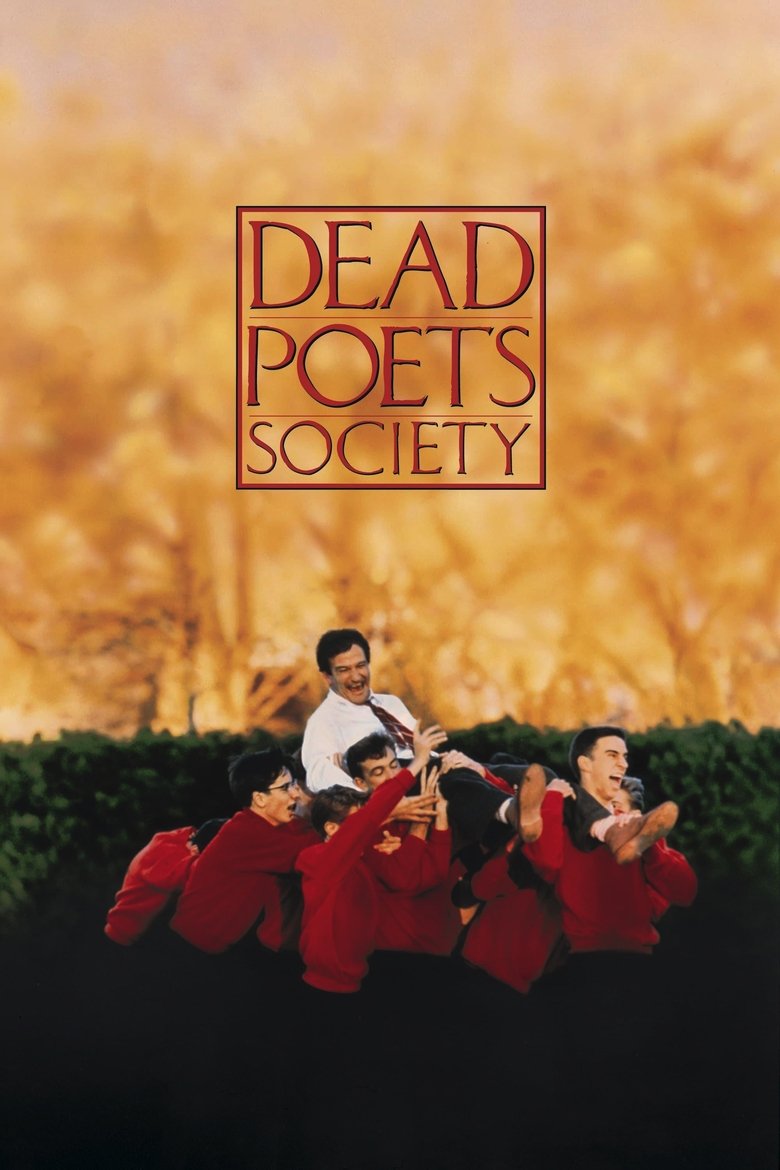
Dead Poets Society
He was their inspiration. He made their lives extraordinary.
- Director
- Peter Weir
- Starring
- Robin Williams, Robert Sean Leonard, Ethan Hawke, Josh Charles
At an elite, old-fashioned boarding school in New England, a passionate English teacher inspires his students to rebel against convention and seize the potential of every day, courting the disdain of the stern headmaster.
Where to watch
Where can I watch Dead Poets Society?
As of October 24, 2026, MovieCove lists Dead Poets Society to rent or buy on Apple TV and Prime Video, and on no subscription service.


Your rating, lists and review
Highlights
What stands out about Dead Poets Society?
Dead Poets Society earns 14 badges, led by Top 1% of films and Stood the test of time.
- Top 1% of films, Rank badge.99th percentile Midcredits score
- Stood the test of time, Reception badge.99th percentile Midcredits score, 37 years on
- Oscar Winner, Awards and box office badge.1 Oscar and 3 more nominations
- Universally Loved, Reception badge.91% rated it 7 or higher
- Best Picture nominee, Awards and box office badge.4 Oscar nominations in all
- Deeply moving, Craft and mood badge.Reviews score it 95 of 100
- Sticks the landing, Craft and mood badge.Reviews score it 92 of 100
- Breakout role, Cast badge.Breakouts for Robin Williams and 2 more
Show 6 moreShow fewer
- Cultural touchstone, Reception badge.Among the most-seen films, 4.7M ratings
- 10× return, Awards and box office badge.Returned 14× its budget
- Standout acting, Craft and mood badge.Reviews score it 88 of 100
- Before they were famous, Cast badge.Ethan Hawke: newcomer then, star now
- Bittersweet, Craft and mood badge.Leaves you bittersweet
- Big Budget, Awards and box office badge.$16M budget
- Rank
- Reception
- Craft and mood
- Awards and box office
- Cast
Reception
Is Dead Poets Society worth watching?
Dead Poets Society's Midcredits score is the 99th percentile of all films, from 4.7M ratings across 6 sources. 91% liked it (rated it 7 or higher out of 10).
Midcredits score
99th percentile
Better received than 99% of films
84 /100
98th percentile of all films
Critics 79 · Audience 84
Rating distribution
votes at each rating level (1–10)
Ratings pile up at 9–10 with almost no detractors — near-universal love.
91% liked it
98th percentile of all films
Critics 85% · Audience 92%
Awards
1 Oscars won · 3 Oscar noms · 18 wins / 18 noms overall
- WonAcademy Awards· Best Writing, Screenplay Written Directly for the Screen
- NominatedAcademy Awards· Best Actor in a Leading Role
99th percentile
4.7M ratings across platforms
Box office
Returned 14.4× its budget — 98th percentile earner in its genre.
What reviewers say
Common ground
Both camps agree the film centers on an unconventional teacher inspiring privileged, impressionable prep-school boys, and that its emotional impact and idealistic message about seizing the day are unequivocally powerful.
Fans praised
- Robin Williams' career-best, soulful performance as John Keating
- Emotional, tearjerking power that inspires viewers to seize the day
- Beautiful cinematography and seamless editing
Detractors panned
- Melodramatic and emotionally manipulative, not earning its tears
- Message of 'think for yourself' undercut by its own preachiness and anti-tradition bias
- Predictable, derivative story that follows formulaic boarding-school tropes
What stands out
Shattering tearjerker that leaves viewers moved and inspired
Iconic, chilling final scene that solidifies the film's emotional and thematic closure
Robin Williams' career-best, restrained and heartfelt performance, supported by strong young cast
Immersive, melancholic yet uplifting prep-school atmosphere
Multidimensional students with relatable arcs, though some critics find them underwritten
Quotable, thought-provoking lines like 'Carpe Diem' and 'O Captain, My Captain' resonate
Inspiring and moving story, though predictable and formulaic for some critics
Derivative of other prep-school and inspirational-teacher films, offering few surprises
Preferred by
No notable difference between any of the groups: each pair ranks it within 10 percentile points.
- Women vs men even
- Under-30s vs over-30s 1 point apart
- Critics vs users 1 point apart
- US vs non-US 2 points apart
Watch experience
What is Dead Poets Society like to watch?
Watch this when you are ready for heavy feelings, and you want a story that moves you and leaves an ache.
What it asks of you
Room for heavy feelings and patience.
What it feels like
Moving and bittersweet.
How it leaves you
Bittersweet.
Story archetype
Every story archetype, clockwise from the top
- Monster 21%: Predator 6% · Tyrant 6% · Invasion 2% · Oppressive state 2% · Corporate villainy 1% · Institutional injustice 1% · Class system under 1% · Technology turns under 1% · Inner demon 1%
- Rags 3%: Underdog triumph 2% · Social ascent under 1% · Fame and fortune under 1% · Rise and fall under 1% · Hidden worth revealed under 1%
- Quest 10%: Treasure hunt 1% · Rescue 4% · Mission 5% · Journey home under 1% · Pilgrimage 1%
- Voyage 4%: Portal fantasy under 1% · Fish out of water 2% · Survival ordeal 1% · Time displacement under 1% · Descent 1%
- Comedy 11%: Romantic comedy 4% · Comedy of errors 3% · Farce 2% · Buddy comedy 1% · Comedy of manners 1%
- Tragedy 9%: Hubris 1% · Obsession 2% · Corruption arc 2% · Doomed love 2% · Crushed by fate 3%
- Rebirth 13% (this title): Redemption 3% · Healing 5% · Liberation 2% (this title) · Second chance 2%
- Mystery 7%: Puzzle 1% · Investigation 5% · Enigma 2%
- No archetype 22%
What it's about
Every theme, clockwise from the top
- Bonds 27%: Romantic love 15% · Marriage 2% · Family bonds 21% · Parenthood 2% · Friendship 9% · Loyalty 4%
- Self 22% (this title): Identity 14% · Coming of age 5% (this title) · Aging under 1% · Self-worth 7% · Ambition 7% · Purpose 9% (this title) · Memory 3% · Obsession 3%
- Power 7%: Power 2% · Corruption 3% · Greed 3% · Class 3% · Oppression 4% · Freedom 5%
- Morality 16%: Justice 13% · Duty 2% · Revenge 4% · Guilt 3% · Redemption 6% · Forgiveness 1% · Sacrifice 4% · Betrayal 5% · Deception 9%
- Survival 15%: Survival 17% · War 1% · Violence 4% · Mortality 2% · Grief 6% · Trauma 7% · Mental illness 1% · Addiction 1% · Illness and disability under 1%
- Society 9%: Community 14% (this title) · Isolation 5% · Prejudice 3% · Displacement 1% · Faith 3% · Tradition vs change 2% · Fame 3% · Legacy 4%
- Ideas 5%: Fate 1% · Free will under 1% · Truth 4% · Hope 5% · Nature 2% · Art 4% · Technology 1%
The world
Content guide
Is Dead Poets Society okay for kids?
PGDead Poets Society is rated PG. As of September 28, 2026, Midcredits content scores put its violence at moderate (37/100), sexual content at moderate (44/100), language at mild (33/100), drug and alcohol content at moderate (40/100) and frightening material at moderate (59/100). Overall it is heavier than 84% of PG-rated films.
Ratings in 20 other countriesRatings elsewhere
- UKPG
- AustraliaPG
- Germany12
- FranceTP
- Ireland12
- JapanPG12
- South Korea12
- Brazil12
- Belgium16
- Denmark7
- FinlandK-12
- Greece12
- Hungary12
- Netherlands6
- Norway9
- Poland12
- PortugalM/12
- RO12
- Spain16
- Sweden11
Point along a line to see a well-known title at that level.
Nothing here is extreme. The strongest element is frightening material, heavier than 88% of PG-rated films.
Source: Midcredits content scores, 0 (none) to 100 (severe) per category, with each standing ranked against other films that have them.
What content warnings does Dead Poets Society have?
MovieCove's classifier found 3 depicted content warnings in Dead Poets Society, all withheld here because they would spoil the plot. Each is backed by a verbatim quote from the parents' guide notes; a missing warning is not a guarantee of absence.
Cast and crew
Who is in Dead Poets Society?
Cast
3 of the 10 billed cast had never appeared on screen.


Crew
Directed by
Written by
Cinematography
Edited by
Music by
Produced by
More like this
What are movies like Dead Poets Society?
Movies like Dead Poets Society include Another Round (2020), School Ties (1992) and Children of a Lesser God (1986). Of the 12 closest matches, half are coming-of-age stories, and half are films set in New England.








Why this pick
Explore by
What else shares a premise, people or place with Dead Poets Society?
6.1K other films share the rarest tag below, relationship: mentor and protégé. Each tag opens Browse with the films that share it.