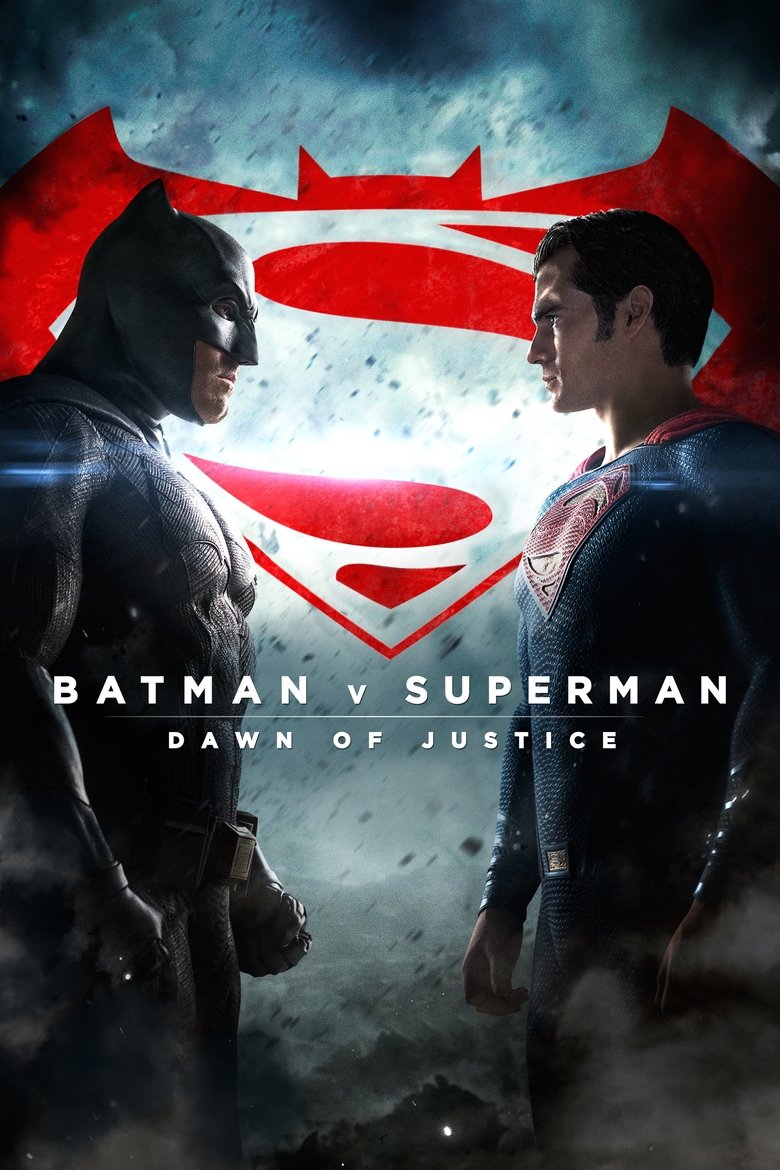
Batman v Superman: Dawn of Justice
The greatest gladiator match in the history of the world.
- Director
- Zack Snyder
- Starring
- Ben Affleck, Henry Cavill, Jesse Eisenberg, Gal Gadot
Fearing the actions of a god-like Super Hero left unchecked, Gotham City’s own formidable, forceful vigilante takes on Metropolis’s most revered, modern-day savior, while the world wrestles with what sort of hero it really needs. And with Batman and Superman at war with one another, a new threat quickly arises, putting mankind in greater danger than it’s ever known before.
Where to watch
Where can I watch Batman v Superman: Dawn of Justice?
As of October 24, 2026, MovieCove lists Batman v Superman: Dawn of Justice streaming on discovery+ via The Roku Channel and HBO Max and to rent or buy on Apple TV and Prime Video.
Subscription




Your rating, lists and review
Highlights
What stands out about Batman v Superman: Dawn of Justice?
Batman v Superman: Dawn of Justice earns 12 badges, led by Top 10% in Sci-Fi and Guilty pleasure.
- Top 10% in Sci-Fi, Rank badge.91st percentile among Sci-Fi films
- Guilty pleasure, Reception badge.Critics 44, audiences 61
- Star-studded, Cast badge.7 of the billed cast already had a top-10% actor's standing
- Crowd Pleaser, Reception badge.57% rated it 7 or higher
- Box Office Hit, Awards and box office badge.Returned 3.5× its budget
- Award Winner, Awards and box office badge.14 wins and 34 more nominations
- Heavy for a PG-13-rated film, Content badge.Heavier than 90% of PG-13-rated films
- Before they were famous, Cast badge.Gal Gadot: newcomer then, star now
Show 4 moreShow fewer
- Rank
- Reception
- Craft and mood
- Awards and box office
- Content
- Cast
Reception
Is Batman v Superman: Dawn of Justice worth watching?
Batman v Superman: Dawn of Justice's Midcredits score is the 54th percentile of all films, from 1.9M ratings across 6 sources. 57% liked it (rated it 7 or higher out of 10).
Midcredits score
54th percentile
Better received than 54% of films
60 /100
44th percentile of all films
Critics 44 · Audience 61
Rating distribution
votes at each rating level (1–10)
A broad spread centered near 6.7 — solid but not unanimous.
57% liked it
62nd percentile of all films
Critics 28% · Audience 63%
Awards
0 Oscars won · 0 Oscar noms · 14 wins / 34 noms overall
91st percentile
1.9M ratings across platforms
Box office
Returned 3.5× its budget — 97th percentile earner in its genre.
What reviewers say
Common ground
Batman v Superman is a dense, visually ambitious, and tonally dark superhero epic, but its labyrinthine plot and inconsistent character motivations divide audiences on whether that ambition pays off.
Fans praised
- Ultimate Edition restores plot coherence and character depth
- Affleck's weary, brutal Batman and Cavill's burdened Superman
- Visually stunning action and Snyder's mythic, brooding tone
Detractors panned
- Muddled, bloated story with lazy motivations and plot holes
- Eisenberg's Lex Luthor as an annoying, unfitting Joker retread
- Dour, self-serious tone and clumsy Justice League setup
What stands out
Visual opulence and stunning shots, some CGI hiccups
Dense, mythic, dark world-building; some find it too grim
Brutal, thrilling fight scenes; Doomsday CGI criticized
Affleck and Cavill praised; Eisenberg polarizing
Batman's brokenness and Superman's burden praised by fans, but critics call them poorly motivated
Ultimate Edition improves but theatrical cut is choppy and slow
Ultimate Edition fills holes but theatrical cut is disjointed; setup feels forced
Maudlin, clunky lines; few laughs
Preferred by
Women vs men
Men scored it 26 points higher than women.
US vs non-US
Non-US viewers scored it 15 points higher than US viewers.
No notable difference between the other groups: each pair ranks it within 10 percentile points.
- Under-30s vs over-30s 5 points apart
- Critics vs users 5 points apart
Watch experience
What is Batman v Superman: Dawn of Justice like to watch?
Watch this when you are ready to pay close attention and feel heavy feelings, and you want to be swept up in something big.
What it asks of you
Your full attention and room for heavy feelings.
What it feels like
Big and sweeping.
How it leaves you
Bittersweet.
Story archetype
Every story archetype, clockwise from the top
- Monster 21% (this title): Predator 6% · Tyrant 6% · Invasion 2% · Oppressive state 2% · Corporate villainy 1% (this title) · Institutional injustice 1% · Class system under 1% · Technology turns under 1% · Inner demon 1%
- Rags 3%: Underdog triumph 2% · Social ascent under 1% · Fame and fortune under 1% · Rise and fall under 1% · Hidden worth revealed under 1%
- Quest 10%: Treasure hunt 1% · Rescue 4% · Mission 5% · Journey home under 1% · Pilgrimage 1%
- Voyage 4%: Portal fantasy under 1% · Fish out of water 2% · Survival ordeal 1% · Time displacement under 1% · Descent 1%
- Comedy 11%: Romantic comedy 4% · Comedy of errors 3% · Farce 2% · Buddy comedy 1% · Comedy of manners 1%
- Tragedy 9%: Hubris 1% · Obsession 2% · Corruption arc 2% · Doomed love 2% · Crushed by fate 3%
- Rebirth 13%: Redemption 3% · Healing 5% · Liberation 2% · Second chance 2%
- Mystery 7%: Puzzle 1% · Investigation 5% · Enigma 2%
- No archetype 22%
What it's about
Every theme, clockwise from the top
- Bonds 27%: Romantic love 15% · Marriage 2% · Family bonds 21% · Parenthood 2% · Friendship 9% · Loyalty 4%
- Self 22%: Identity 14% · Coming of age 5% · Aging under 1% · Self-worth 7% · Ambition 7% · Purpose 9% · Memory 3% · Obsession 3%
- Power 7%: Power 2% (this title) · Corruption 3% · Greed 3% · Class 3% · Oppression 4% · Freedom 5%
- Morality 16% (this title): Justice 13% (this title) · Duty 2% · Revenge 4% · Guilt 3% · Redemption 6% (this title) · Forgiveness 1% · Sacrifice 4% · Betrayal 5% · Deception 9%
- Survival 15%: Survival 17% · War 1% · Violence 4% · Mortality 2% · Grief 6% · Trauma 7% · Mental illness 1% · Addiction 1% · Illness and disability under 1%
- Society 9%: Community 14% · Isolation 5% · Prejudice 3% · Displacement 1% · Faith 3% · Tradition vs change 2% · Fame 3% · Legacy 4%
- Ideas 5%: Fate 1% · Free will under 1% · Truth 4% · Hope 5% · Nature 2% · Art 4% · Technology 1%
The world
Content guide
Is Batman v Superman: Dawn of Justice okay for kids?
PG-13Batman v Superman: Dawn of Justice is listed as PG-13, but the MPAA's rating reason reads “Rated R for sequences of violence”. As of September 28, 2026, Midcredits content scores put its violence at intense (72/100), sexual content at mild (35/100), language at moderate (50/100), drug and alcohol content at mild (30/100) and frightening material at intense (67/100). Overall it is heavier than 90% of PG-13-rated films.
Ratings in 38 other countriesRatings elsewhere
- UK12A
- CanadaPG
- AustraliaM
- Germany12
- France12
- Ireland12
- New ZealandM
- JapanG
- South Korea12
- Brazil12
- Argentina+13
- Belgium12
- BGC
- Czechia15+
- Denmark11
- FinlandK-16
- GreeceK12
- Hong KongIIB
- Hungary12
- IndiaUA
- IsraelAll
- ItalyT
- LTN-13
- MexicoB
- MYP13
- Netherlands12
- Norway15
- Poland16
- PortugalM/14
- RO18
- Russia16+
- SingaporePG13
- Spain12
- Sweden11
- Switzerland16
- Taiwan6+
- Türkiye13A
- UA16+
Point along a line to see a well-known title at that level.
The reason to think twice is violence and frightening material. Everything else sits at or below what PG-13-rated films usually carry.
Source: Midcredits content scores, 0 (none) to 100 (severe) per category, with each standing ranked against other films that have them.
What content warnings does Batman v Superman: Dawn of Justice have?
MovieCove's classifier found 6 depicted content warnings in Batman v Superman: Dawn of Justice: Death of a parent (severe), Gun violence (severe), Torture (moderate), Self-harm (mild), plus 2 withheld here because they would spoil the plot. Each is backed by a verbatim quote from the parents' guide notes; a missing warning is not a guarantee of absence.
Cast and crew
Who is in Batman v Superman: Dawn of Justice?
Cast
7 of the cast already had the standing of a top-10% working actor.







Crew
Directed by
Written by
Cinematography
Edited by
Music by
More like this
What are movies like Batman v Superman: Dawn of Justice?
Movies like Batman v Superman: Dawn of Justice include Man of Steel (2013), The Dark Knight Rises (2012) and Max Payne (2008). Of the 12 closest matches, several are films written by David S. Goyer, and most are superhero films.
- Man of SteelWorld:
- The Dark Knight RisesPeople:
- Max PayneStory type:
- SteamboyReception:
- Captain America: Civil WarSubject:
- Rebel Moon - Part One: A Child of FireFeel:
- Ghost Rider: Spirit of VengeancePeople:
- The Dark KnightPeople:
- The CrowWorld:
- Suicide SquadSubject:
- Secret HeadquartersStory type:
- WatchmenWorld:





Why this pick
Explore by
What else shares a premise, people or place with Batman v Superman: Dawn of Justice?
605 other films share the rarest tag below, follows: superhero. Each tag opens Browse with the films that share it.