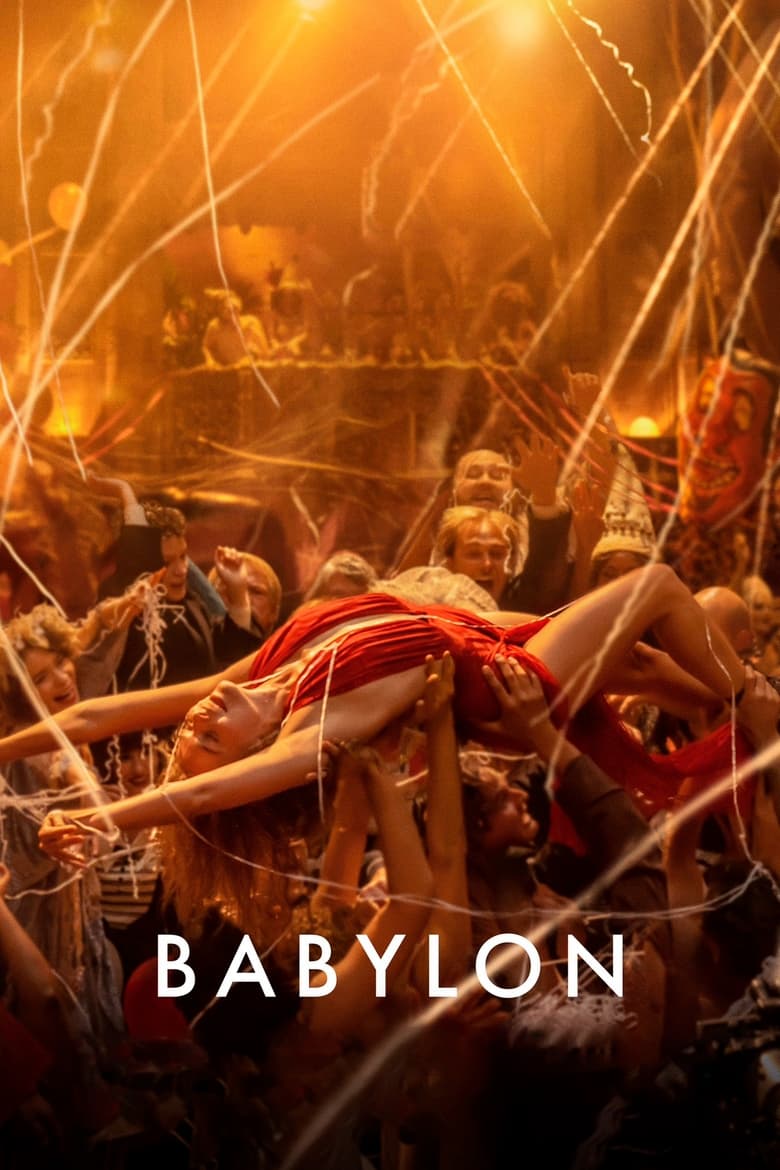
Babylon
Always make a scene.
- Director
- Damien Chazelle
- Starring
- Diego Calva, Margot Robbie, Brad Pitt, Jovan Adepo
A tale of outsized ambition and outrageous excess, tracing the rise and fall of multiple characters in an era of unbridled decadence and depravity during Hollywood's transition from silent films to sound films in the late 1920s.
Where to watch
Where can I watch Babylon?
As of October 24, 2026, MovieCove lists Babylon streaming on Hulu and Paramount+ and to rent or buy on Apple TV and Prime Video.
Subscription


Your rating, lists and review
Highlights
What stands out about Babylon?
Babylon earns 16 badges, led by Top 10% in Comedy and Standout soundtrack.
- Top 10% in Comedy, Rank badge.90th percentile among Comedy films
- Standout soundtrack, Craft and mood badge.Praised by fans (95) and detractors (80)
- Visual feast, Craft and mood badge.Praised by fans (88) and detractors (78)
- Crowd Pleaser, Reception badge.72% rated it 7 or higher
- Award Winner, Awards and box office badge.24 wins and 76 more nominations
- Breakout role, Cast badge.Diego Calva's breakout
- Heavy for an R-rated film, Content badge.Heavier than 98% of R-rated films
- Box Office Flop, Awards and box office badge.Grossed 81% of its budget
Show 8 moreShow fewer
- Standout acting, Craft and mood badge.Praised by fans (85) and detractors (75)
- Preferred by Men, Reception badge.Men scored it 23 points higher than women
- Preferred by Under-30s, Reception badge.Under-30s scored it 23 points higher than over-30s
- Preferred by Non-US Viewers, Reception badge.Non-US viewers scored it 21 points higher than US viewers
- Bittersweet, Craft and mood badge.Leaves you bittersweet
- Strong sexual content, Content badge.Sex & Nudity heavier than 98% of films
- Strong language, Content badge.Profanity heavier than 96% of films
- Big Budget, Awards and box office badge.$80M budget
- Rank
- Reception
- Craft and mood
- Awards and box office
- Content
- Cast
Reception
Is Babylon worth watching?
Babylon's Midcredits score is the 85th percentile of all films, from 1.3M ratings across 6 sources. 72% liked it (rated it 7 or higher out of 10).
Midcredits score
85th percentile
Better received than 85% of films
72 /100
86th percentile of all films
Critics 61 · Audience 73
Rating distribution
votes at each rating level (1–10)
A broad spread centered near 7.2 — solid but not unanimous.
72% liked it
81st percentile of all films
Critics 57% · Audience 53%
Awards
0 Oscars won · 2 Oscar noms · 24 wins / 76 noms overall
- NominatedAcademy Awards· Best Achievement in Music Written for Motion Pictures (Original Score)
- NominatedAcademy Awards· Best Achievement in Production Design
79th percentile
1.3M ratings across platforms
Box office
Returned 0.8× its budget — 93rd percentile earner in its genre.
What reviewers say
Common ground
A long, messy, and wildly excessive spectacle about Hollywood's transition from silent to sound films.
Fans praised
- Vibrant opening sequence with manic energy
- Stunning cast performances, especially Robbie and Pitt
- Justin Hurwitz's exhilarating score
Detractors panned
- Bloated runtime with self-indulgent excess
- Scattershot plot with too many pointless subplots
- Juvenile shock-value gross-out scenes
What stands out
Hurwitz's score called mesmerizing, crucial to the film's energy
Gorgeous visuals, lavish production design, sweeping camera work
Cast uniformly praised, Robbie's ferocity and Pitt's warmth singled out
Immersive, decadent 1920s Hollywood world-building
Thinly written archetypes, arcs feel familiar or underdeveloped
Fragmented narrative, loses focus after first act, too many tangents
Multiple false endings, pretentious montage, unsatisfying
First hour electric, then drags severely; 30-40 minutes too long
Preferred by
Women vs men
Men scored it 23 points higher than women.
Under-30s vs over-30s
Under-30s scored it 23 points higher than over-30s.
US vs non-US
Non-US viewers scored it 21 points higher than US viewers.
No notable difference between the other groups: each pair ranks it within 10 percentile points.
- Critics vs users 1 point apart
Watch experience
What is Babylon like to watch?
Watch this when you are ready for heavy feelings, and you want to laugh at things you probably shouldn't.
What it asks of you
Room for heavy feelings.
What it feels like
Dark comedy.
How it leaves you
Bittersweet.
Story archetype
Every story archetype, clockwise from the top
- Monster 21%: Predator 6% · Tyrant 6% · Invasion 2% · Oppressive state 2% · Corporate villainy 1% · Institutional injustice 1% · Class system under 1% · Technology turns under 1% · Inner demon 1%
- Rags 3%: Underdog triumph 2% · Social ascent under 1% · Fame and fortune under 1% · Rise and fall under 1% · Hidden worth revealed under 1%
- Quest 10%: Treasure hunt 1% · Rescue 4% · Mission 5% · Journey home under 1% · Pilgrimage 1%
- Voyage 4%: Portal fantasy under 1% · Fish out of water 2% · Survival ordeal 1% · Time displacement under 1% · Descent 1%
- Comedy 11%: Romantic comedy 4% · Comedy of errors 3% · Farce 2% · Buddy comedy 1% · Comedy of manners 1%
- Tragedy 9% (this title): Hubris 1% · Obsession 2% · Corruption arc 2% (this title) · Doomed love 2% · Crushed by fate 3%
- Rebirth 13%: Redemption 3% · Healing 5% · Liberation 2% · Second chance 2%
- Mystery 7%: Puzzle 1% · Investigation 5% · Enigma 2%
- No archetype 22%
What it's about
Every theme, clockwise from the top
- Bonds 27%: Romantic love 15% · Marriage 2% · Family bonds 21% · Parenthood 2% · Friendship 9% · Loyalty 4%
- Self 22% (this title): Identity 14% · Coming of age 5% · Aging under 1% · Self-worth 7% · Ambition 7% (this title) · Purpose 9% · Memory 3% · Obsession 3%
- Power 7%: Power 2% · Corruption 3% (this title) · Greed 3% · Class 3% · Oppression 4% · Freedom 5%
- Morality 16%: Justice 13% · Duty 2% · Revenge 4% · Guilt 3% · Redemption 6% · Forgiveness 1% · Sacrifice 4% · Betrayal 5% · Deception 9%
- Survival 15%: Survival 17% · War 1% · Violence 4% · Mortality 2% · Grief 6% · Trauma 7% · Mental illness 1% · Addiction 1% · Illness and disability under 1%
- Society 9%: Community 14% · Isolation 5% · Prejudice 3% · Displacement 1% · Faith 3% · Tradition vs change 2% · Fame 3% (this title) · Legacy 4%
- Ideas 5%: Fate 1% · Free will under 1% · Truth 4% · Hope 5% · Nature 2% · Art 4% · Technology 1%
The world
Content guide
Is Babylon okay for kids?
RBabylon is rated R: “Rated R for strong and crude sexual content, graphic nudity, bloody violence, drug use, and pervasive language” (MPAA). As of September 28, 2026, Midcredits content scores put its violence at severe (84/100), sexual content at severe (82/100), language at severe (91/100), drug and alcohol content at severe (91/100) and frightening material at intense (78/100). Overall it is heavier than 98% of R-rated films.
Ratings in 41 other countriesRatings elsewhere
- UK18
- Canada18A
- AustraliaMA 15+
- Germany16
- FranceTP
- Ireland18
- New ZealandR18
- JapanR15+
- South Korea19
- Brazil18
- Argentina+16
- Belgium16
- Czechia15+
- Denmark15
- FinlandK-16
- GreeceK18
- Hong KongIII
- Hungary18
- ID17+
- Israel16
- Italy14+
- LTN-16
- LU16
- LV16+
- MexicoC
- MOD
- Netherlands16
- Norway15
- PhilippinesR-16
- Poland18
- PortugalM/16
- PRPG-13
- SingaporeR21
- SK15
- South Africa18
- Spain16
- Sweden15
- Switzerland16
- Taiwan18+
- TH18
- Türkiye18+
Point along a line to see a well-known title at that level.
Heavy almost across the board: language, drug and alcohol content, violence, sexual content, and frightening material.
Source: Midcredits content scores, 0 (none) to 100 (severe) per category, with each standing ranked against other films that have them.
What content warnings does Babylon have?
MovieCove's classifier found 8 depicted content warnings in Babylon: Addiction or relapse (severe), Gore or body horror (severe), Animal cruelty (moderate), Animal death (moderate), Drug overdose (moderate), Hate-motivated violence (mild), plus 2 withheld here because they would spoil the plot. 1 more is mentioned only, in dialogue or backstory (behind the spoiler gate). Each is backed by a verbatim quote from the parents' guide notes; a missing warning is not a guarantee of absence.
Mentioned: referenced in dialogue or backstory, not shown in the story’s present.
Cast and crew
Who is in Babylon?
Cast
2 of the cast already had the standing of a top-10% working actor.


Crew
Directed by
Written by
Cinematography
Edited by
Music by
More like this
What are movies like Babylon?
Movies like Babylon include The Artist (2011), Rock of Ages (2012) and La La Land (2016). Of the 11 closest matches, several are corruption arc stories, and most are films set in Los Angeles.




Explore by
What else shares a premise, people or place with Babylon?
4.7K other films share the rarest tag below, relationship: whirlwind romance. Each tag opens Browse with the films that share it.